What we saw in 2019: An increased desire by hiring committees to see a diversity of candidates. Even if it meant waiting to make an offer to a great candidate who had already finished the interview process and done well, Another factor was the desire to not miss out on someone who didn’t show up in the first search.
2020 Trend: Clients will continue to wait to ensure that they have the perfect person for the role.
This year, “culture fit” and personality traits that work well with the current executive staff of the company became more and more important. These organizations wanted to hire someone that would play nicely with the rest of the team. Furthermore, they wanted to avoid hiring someone that would rock the boat too much. This played into turnover and retention improvement plans as well.
2020 Trend: Companies will continue to put a lot of weight on hiring people whose personalities will fit in with theirs. When you hire an aggressive change agent, your staff may get upset and decide to look for work elsewhere.
The number of jobs we saw slow down around holidays like Christmas and the Fourth of July in 2019. It seemed like more people were taking vacations since the economy was better, which can slow down the interview process a bit.
2020 Trend: Candidates will continue traveling around the holiday seasons, slowing down the interview and hiring process. Recruiters and hiring managers will need to adjust accordingly.
The searches we did were mostly for executive level jobs (VP and above), which is what we plan to keep doing this year. We saw that companies were extending the interview process (vetting process) with candidates. Four to nine interviews were common before an offer was made, which meant that more than one person was involved in the hiring process. To get full support, they included not only the leadership team the person will be reporting to, but also the person who will be reporting directly to them in the future. Because of this, it was a little harder to place someone because one bad review from one of the many interviewers could take someone out of the process. Dennis Theodorou, our managing director, had already said that this was not a good time to get a job because there were too many cooks in the kitchen.
2020 Trend: Interviews will be shorter in 2020 because businesses don’t want to get bad reviews on sites like Glassdoor.
What we saw: Skype and Teams were still popular. Some companies had also used pre-recorded video interviews that candidates could watch whenever they had time and send in when they were done. Candidates had mixed feelings about these interviews. Some really liked the flexibility, others felt it was awkward.
In 2020, jobs will use this method for interviews, and video interviews will continue to become more popular.
What we saw: Hiring with an emphasis on succession planning. Clients wanted to hire people who could do well in both the jobs we were hiring for and the jobs above them more than ever. This helped us find a lot of people who were overqualified for the job we were hiring for but were still interested in the long-term chance to grow with an exciting company.
2020 Trend: Companies will look to develop new leaders when hiring by implementing more leadership training programs
Getting hired at a top executive search firm like JMJ Phillip is no easy feat. With over two decades of experience placing leaders across industries, JMJ Phillip receives thousands of applicants every year. So how do you stand out and prove you’re the right candidate during the JMJ Phillip interview process?
Preparation is key. In this article, we’ll dive into the top 20 most common JMJ Phillip interview questions, and how to craft winning answers that showcase your skills. From questions about your recruiting expertise to situational scenarios, we’ll cover exactly what JMJ Phillip hiring managers want to hear.
Whether you have an interview scheduled or just want to get a head start on the process use this inside look to ace your JMJ Phillip job interview!
Overview of the JMJ Phillip Interview Process
Before we jump into specific questions let’s do a quick rundown of what to expect during the interview process at JMJ Phillip
-
Initial phone screen – A recruiter will have a short 30 minute call to discuss your resume and qualifications. Basic questions about your background will be asked here.
-
Video interview – Next, you’ll likely have a more in-depth video interview over Zoom or FaceTime with one or more JMJ Phillip employees The questions here will dive deeper into your relevant experience.
-
In-person interview – For many roles, there will be an in-person interview at the JMJ Phillip office. This is often a full day of various meetings and assessments.
-
Final interview – Finally, a last round interview with senior leadership will evaluate your fit within the company.
Now let’s look at some of the most frequently asked questions from each stage:
Top 20 JMJ Phillip Interview Questions and Answers
Phone Screen Questions
1. Walk me through your experience in recruitment, particularly in executive search.
JMJ Phillip wants to understand your background right out of the gate. Be prepared to give an overview of your relevant experience in talent acquisition, focusing on any executive recruitment experience. Discuss roles, responsibilities, and companies you’ve worked with. Quantify your success with metrics like placements made or time-to-fill improved.
Sample Answer:
“Throughout my 12 year recruiting career, I’ve focused exclusively on executive search roles. My experience began at Harris Search Associates, where I started as a researcher before being promoted to recruiter. There, I spearheaded C-suite searches across technology and healthcare, placing over 50 executives during my tenure. Most recently, I’ve been an Executive Recruiter at Longford Partners, leading searches for Fortune 500 leadership positions. Last year alone, I filled 13 critical executive roles, reducing time-to-fill by 30%. My proven success in strategic executive recruitment has prepared me well for a role at a distinguished firm like JMJ Phillip.”
2. Why are you interested in a recruiter position with JMJ Phillip?
JMJ Phillip wants to gauge your genuine interest. Express your passion for talent acquisition, and why you feel you would thrive in JMJ Phillip’s meritocratic culture. Research their specializations and niche focus to reference what excites you.
Sample Answer:
“I’m highly interested in JMJ Phillip because of your specialized approach to executive search. Your firm’s reputation for partnering deeply with clients to find transformational leadership talent aligns perfectly with my values and areas of expertise. I’m inspired by JMJ Phillip’s high-performance culture and dedication to best-in-class service. Having focused my career on senior-level search, I know I could make an immediate strategic impact while also developing new capabilities in JMJ Phillip’s distinct approach.”
Video Interview Questions
3. Describe a time when you had to source candidates for a highly specialized role and how you approached this challenge.
JMJ Phillip wants to know you can tackle niche recruiting challenges. Outline your process for breaking down hard-to-fill requirements, leveraging networks, and employing creative sourcing tactics until the right candidate is found. Showcase your persistence and resourcefulness.
Sample Answer:
“One of the most specialized roles I’ve sourced for was a Chief Actuary position for an insurance firm undergoing rapid growth. With highly technical skills needed, I knew traditional job boards wouldn’t suffice. After analyzing the specialized actuarial credentials required, I tapped into niche professional groups on LinkedIn to engage passive candidates. I also worked closely with the hiring manager to identify competitors likely to have this talent. Taking a targeted approach, I reached out directly to actuaries at those firms, selling them on the exciting proposition of shaping the strategy of a scaling company. Within two months I successfully recruited a Chief Actuary ready to embrace the challenge.”
4. Tell me about a time you provided consultative guidance to a hiring manager. What was the situation and outcome?
JMJ Phillip wants to understand your partnership with hiring managers. Choose an example that highlights your ability to provide strategic guidance, not just carry out orders. Share how your input enhanced the recruiting process and resulted in a better outcome.
Sample Answer:
“One situation where I provided meaningful consultative guidance was for a client attempting to source more diverse candidates for technology roles. I advised them that the job descriptions, while listing hard skills, lacked diversity and inclusion messaging. I recommended incorporating more information on company values, community outreach, and professional development opportunities. The hiring manager agreed to test my suggestions. The result was a major increase in both the quality and diversity of applicants compared to previous recruiting cycles, which the client was thrilled with. It was a great example of using my industry knowledge to improve process and results.”
5. How would you go about researching competitors in the talent acquisition space to inform our strategy?
Here JMJ Phillip wants to understand your approach to competitive intelligence gathering. Demonstrate you know how to leverage tools like LinkedIn, job boards, and professional networks to obtain useful intel. Share how you’d analyze and apply insights to enhance your firm’s recruiting.
Sample Answer:
“I’d start by thoroughly evaluating competitors’ current job postings to identify common requirements, salaries, and recruiting messaging. This establishes a baseline of their strategies. Next, through my own professional network and connections on LinkedIn, I’d aim to find individuals who work in recruiting at those firms, and set up informational interviews to gather insider perspectives. I’d also make it a point to actively engage in industry associations and events where I can build connections and learn the latest recruiting trends. By piecing together these various sources, I can uncover our competitors’ strengths, weaknesses, and any gaps in the market we can capitalize on through our own recruiting approach.”
In-Person Interview Questions
6. Share a time when you successfully negotiated a challenging situation with a candidate.
JMJ Phillip needs recruiters that can finesse tricky negotiations. Choose an example that demonstrates your ability to read motivations, problem-solve creative solutions, and ultimately close the deal for a complex scenario. Share your preparation process and negotiating approach.
Sample Answer:
“I once negotiated an offer for a Director role with an ambitious candidate that had received a strong counteroffer from their current employer. Having built trust and understanding their priorities during the interview process, I knew salary wasn’t their main driver, but career growth was. I re-positioned our offer to expand professional development investments like executive coaching and global mobility. I also accelerated the timeline for Director to VP promotion. These meaningful add-ons allowed me to retain the candidate without stretching budget. It was a great example of finding a win-win negotiation solution.”
7. How would you go about creating or improving our employer brand to attract top talent?
JMJ Phillip seeks recruiters who understand employer brand best practices. Share creative strategies you’ve used or would employ if hired. Demonstrate you know how to highlight culture, leverage employee testimonials, and position the company as an attractive place to work.
Sample Answer:
“I’d take a multi-channel approach to showcase authentic aspects of life at JMJ Phillip to attract top applicants. For example, I would have leadership or respected senior employees write LinkedIn articles or blog posts about company values, development opportunities, and what makes JMJ Phillip’s mission meaningful. I’d create employee testimonial videos covering topics like culture, work/life balance, or a day in the life. And I’d leverage new hire spotlights on social media channels to generate buzz. The goal is conveying the reality of the company, while aligning with the types of messages that resonate most with the talent we aim to recruit.”
8. Walk me through how you would approach a search for a hard-to-fill senior executive role in an industry you’re less familiar with.
JMJ Phillip values resourcefulness and learning agility. Demonstrate you know how to quickly get up to speed on unfamiliar functions and industries through research. Share how you’d tap into networks and niche locations to find the perfect match for a tricky position.
Sample Answer:
“First, I’d request an intake meeting with the hiring manager to deeply understand the role requirements, challenges, and key characteristics needed to excel in that industry. From there, extensive research would help me immerse myself quickly in the sector’s unique lingo, talent landscape, and professional forums. Rather than just posting a generic
A different perspective on the next 12 months of manufacturing employment in the United States.
Going into the second quarter of 2024, the job outlook for manufacturing workers is complicated. It depends on a lot of different economic, technological, and political factors. Some parts of the manufacturing sector may slow down because of how people act and the state of the economy as a whole, but others may grow because of changes in strategy and government spending.
Why a retained search versus a contingent search?
In reality, they are not the same “level” of service, even though they look like it. In the contingent search world, the recruiter only gets paid if a hire is made. Somehow that rhymes, but say it with me: the recruiter only gets paid if a hire is made. So step into a contingent recruiter’s shoes for just a moment. You spend months working on a search, then the company decides to put the search on hold.
What a minute. What?
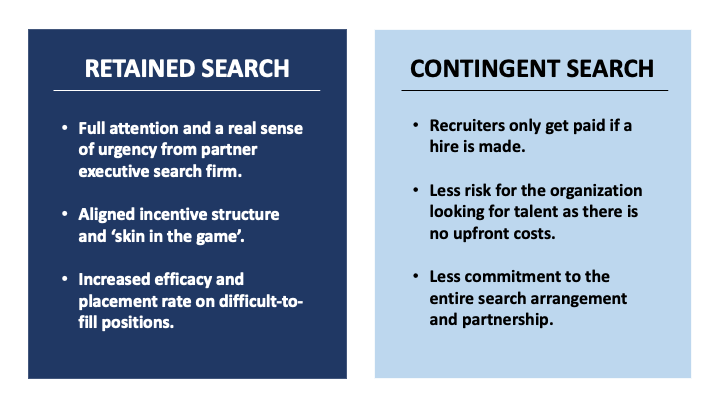
Yes, it happens. It often happens more than 50% of the time actually. Since contingent recruiters know this, they will always put their best effort into the jobs they think will lead to a hire. And you can’t blame them. Some people work on things for months without getting paid. It sounds silly, but that’s the game, and you can still make a good living if you have enough contingent deals.
You can also learn more about the Executive Search industry through the AESC.
While a retained search, especially an executive search where you have the hiring managers’ direct ear, is likely to have a success rate well into the 90% range That’s why, in 2021, when you hire a retained executive search firm, you know they’ll give you their full attention and act quickly because they know you will too.
How to Answer Behavioral Interview Questions Sample Answers
FAQ
What questions are asked at the GT interview?